
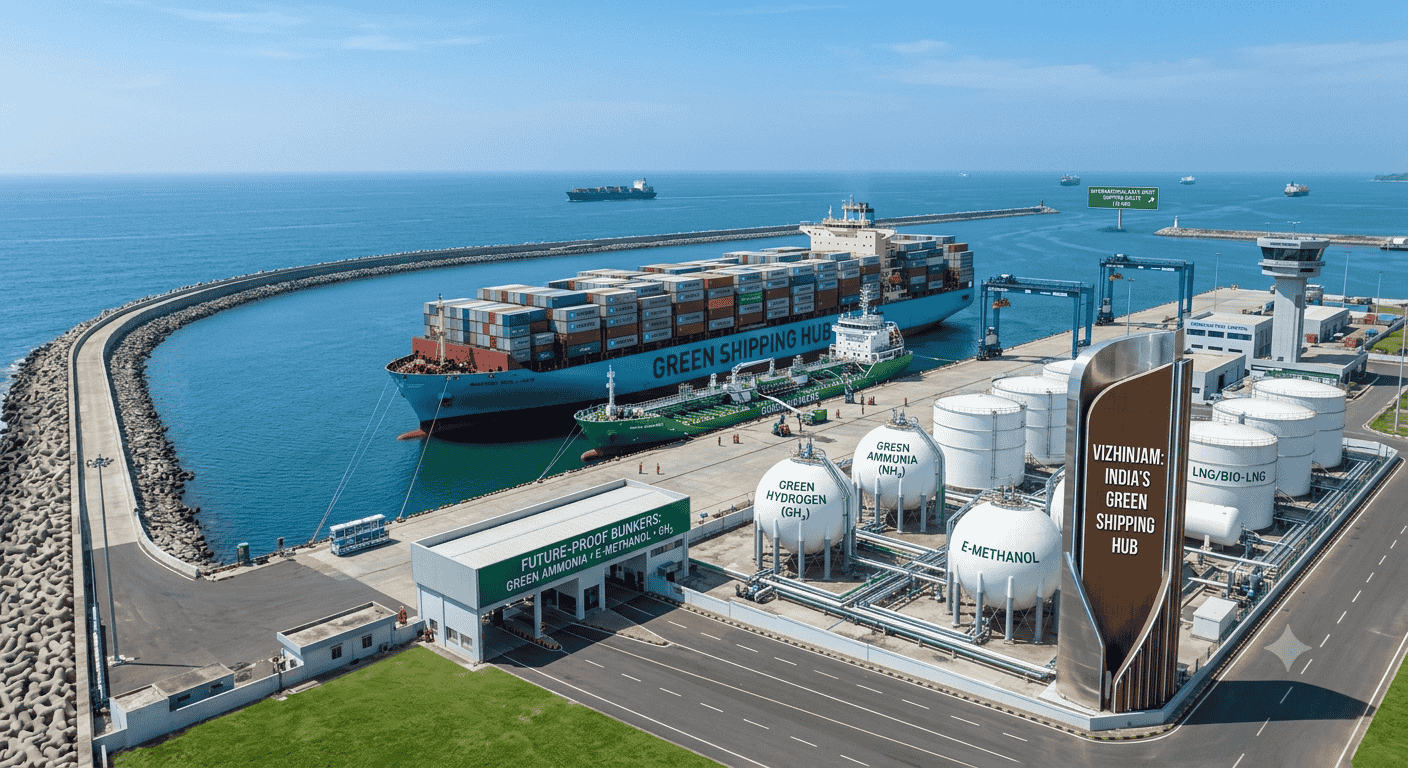
India’s marine industry is at a crossroads as the world’s shipping industry makes a transition to more eco-friendly shipping and low-emission shipping. The Vizhinjam Green Bunkering Plan that is underway in Kerala might provide an opportunity for the region to move out of traditional cargo operations and integrate into this new green-shipping industry.
It is worth noting that Vizhinjam is in proximity to the East–West shipping corridor that is one of the major shipping lanes in the world and has already been developed into a deepwater transshipment port. The year 2026 saw the green bunkering plan added to the list of objectives of Kerala’s revised Budget and Mission Samudra, with Vizhinjam to be developed into a major green bunkering port.
For business people, shipping personnel, and everyone interested in Kerala’s maritime industry, Keralaport brings you up-to-date information about the industry.
What Is Green Bunkering?
In the context of bunkering, this involves providing fuel or energy to ships. Traditionally, ships have been highly reliant on marine fuels. In the case of green bunkering, on the other hand, this entails supplying lower carbon or zero/near-zero emission fuels/energy.
These could include:
- LNG and other lower carbon marine fuels
- Green methanol
- Green ammonia
- Hydrogen fuels
- Sustainable biofuels
- Any other renewable/near-zero carbon energy source
The process is motivated by climate goals on an international level. The 2023 greenhouse gas strategy from the International Maritime Organization seeks for ships to achieve net-zero GHG emissions in or around 2050 while pursuing a minimum of 5%, with an aim of 10%, of shipping energy use coming from zero/near-zero GHG technologies, fuels and energy sources by 2030.
For a port situated right in the middle of an international shipping route, this represents a significant long-term opportunity.
Why Is Vizhinjam Important for Green Bunkering?
There are a number of factors that make Vizhinjam suitable for future bunkering operations.
Firstly, its proximity to the international shipping lane enables vessels to use the facility for bunkering purposes without the need for diverting from their course. Secondly, Vizhinjam’s deep-water facilities make it possible to handle large vessels effectively. According to the development report of Kerala, Vizhinjam has natural depths of more than 20 meters with minimal dredging efforts required.
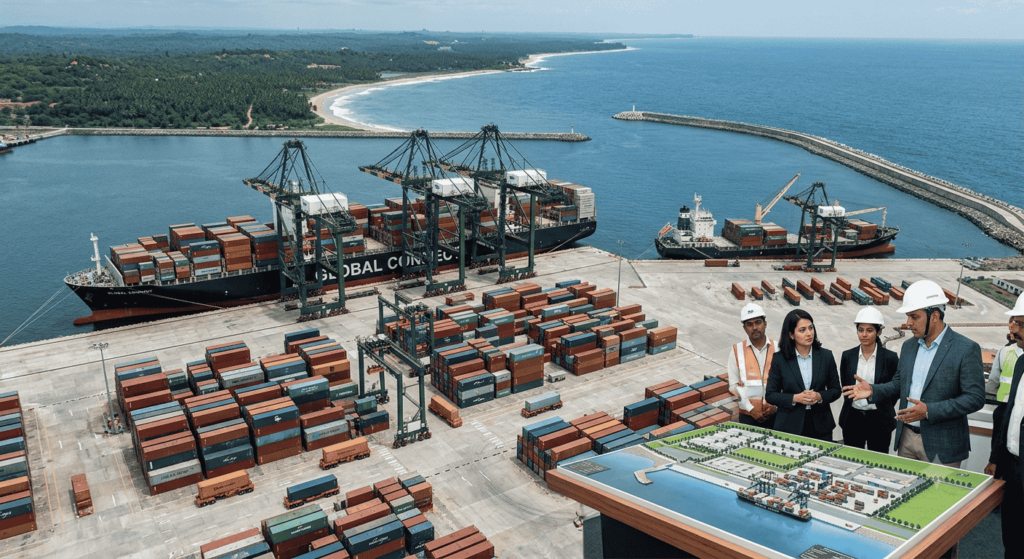
Moreover, Vizhinjam is developing very quickly as a business facility. The first phase of the project began operations in December 2024, whereas the expansion phases II, III and IV, which are planned to be completed in December 2028, will bring the capacity of 3 million TEUs per year, with a possibility to reach 5.7 million TEUs through automation.
India’s First LNG Bunkering Facility: An Important Step
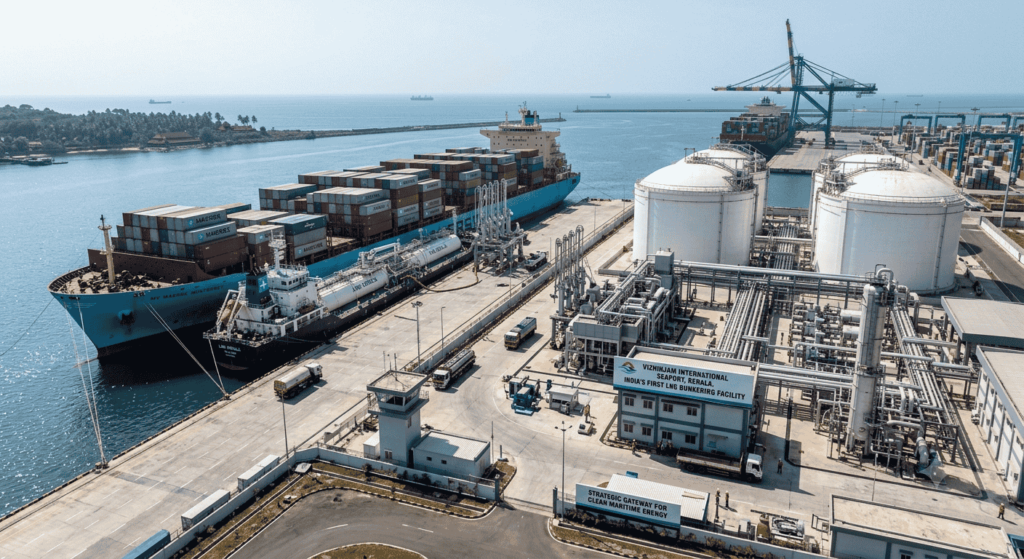
One of the most significant developments connected with Vizhinjam’s green-fuel ambitions is the plan for an LNG ship-to-ship bunkering facility.
Reports in late 2025 said Vizhinjam was set to become the site of India’s first ship-to-ship LNG bunkering facility. The proposed development is intended to strengthen the port’s position as a low-carbon shipping gateway along the Indian Ocean trade route.
LNG should not automatically be treated as a zero-carbon fuel. However, its role in the transition is important because it can offer lower emissions than some conventional marine fuels, while the shipping industry develops and scales truly zero- or near-zero-carbon alternatives.
The bigger opportunity for Vizhinjam is therefore not simply LNG bunkering, but building the infrastructure, expertise and commercial ecosystem required for the next generation of marine fuels.
From LNG to Green Methanol, Ammonia and Hydrogen
The future of green bunkering will likely involve more than one fuel.
The IMO notes that different alternative fuels will require different infrastructure. Methanol, ammonia and hydrogen, for example, have different storage, handling and safety requirements.
This means Kerala will need to think beyond installing a fuel terminal. A competitive green-bunkering ecosystem would require:
- Safe fuel storage and handling facilities
- Dedicated bunkering infrastructure
- Reliable renewable-energy supply
- Fuel transportation and distribution networks
- Skilled maritime workforce
- Clear safety and environmental standards
- Investment from energy companies and shipping lines
- Reliable demand from vessels
Vizhinjam’s existing logistics-development plans could provide an important foundation for this wider ecosystem. The port’s official business-development information identifies international bunkering and logistics infrastructure among the planned investments around the port.
Can Kerala Become India’s Green Shipping Hub?
It may happen in the future—but only if it is done well.
Kerala has a distinct geographical advantage, as well as an international port that is growing in its importance and a lengthy coastline. The state’s Mission Samudra program, which has been funded by the amount of ₹400 crore, aims to develop a larger economic ecosystem through the development of ports, logistics, transportation and others.
But in order to become a real green-shipping hub, Kerala needs much more than just to announce such a project.
First of all, it needs competitive pricing of fuel, proper supply, private investment, collaboration with international shipping companies, and stable infrastructure. At the moment, the whole of India is facing such problems. As reported in February 2026, the program of GreenVoyage2050 by the IMO brought together the Indian maritime community to discuss the alternative marine fuels and possibility of becoming a competitive bunkering hub.
What Could This Mean for Kerala?
Successful green-bunkering development could create opportunities beyond the port itself.
It could support:
- Shipping and marine services
- Logistics and warehousing
- Renewable-energy projects
- Green-fuel production
- Engineering and equipment manufacturing
- Ship maintenance and retrofitting
- Skilled maritime employment
- Export-oriented industries
It could also strengthen Vizhinjam’s position as a full maritime-services hub rather than simply a container transshipment facility.
The IMO itself identifies port infrastructure for alternative fuels and renewable shore-side power as important components of the global transition towards lower-emission shipping.
The Road Ahead
The Vizhinjam Green Bunkering Plans are still part of a broader development journey. Not every proposed green-fuel facility is operational today, and the transition to alternative fuels will require substantial investment, regulation and coordination.
Nevertheless, the direction is becoming clearer. Vizhinjam is expanding its cargo operations, Kerala is developing a wider port-led economic strategy, and global shipping is actively searching for cleaner fuel solutions.
The opportunity for Kerala is to connect all three trends.
If Vizhinjam can combine its strategic location with reliable green-fuel infrastructure, renewable energy, logistics connectivity and international shipping partnerships, it could become one of India’s important gateways for the next generation of maritime trade.
Conclusion
However, the Vizhinjam Green Bunkering Plans are far more important than just delivering an alternative fuel to ships. They can help Kerala join the global shift towards more environmentally friendly maritime transportation, while also opening new doors for energy, logistics, manufacturing, and shipping.
The path is likely going to take time and there are still many hurdles, including fuel availability, costs, technology and infrastructure. However, with the location, deep water port and evolving maritime eco-system that Vizhinjam has, Kerala has all the potential for playing an important part in green shipping in India.
To stay up-to-date on the news about Kerala’s ports, airports, shipping and maritime infrastructure, follow Keralaport.
Keep up-to-date with the latest Kerala port news from Keralaports