
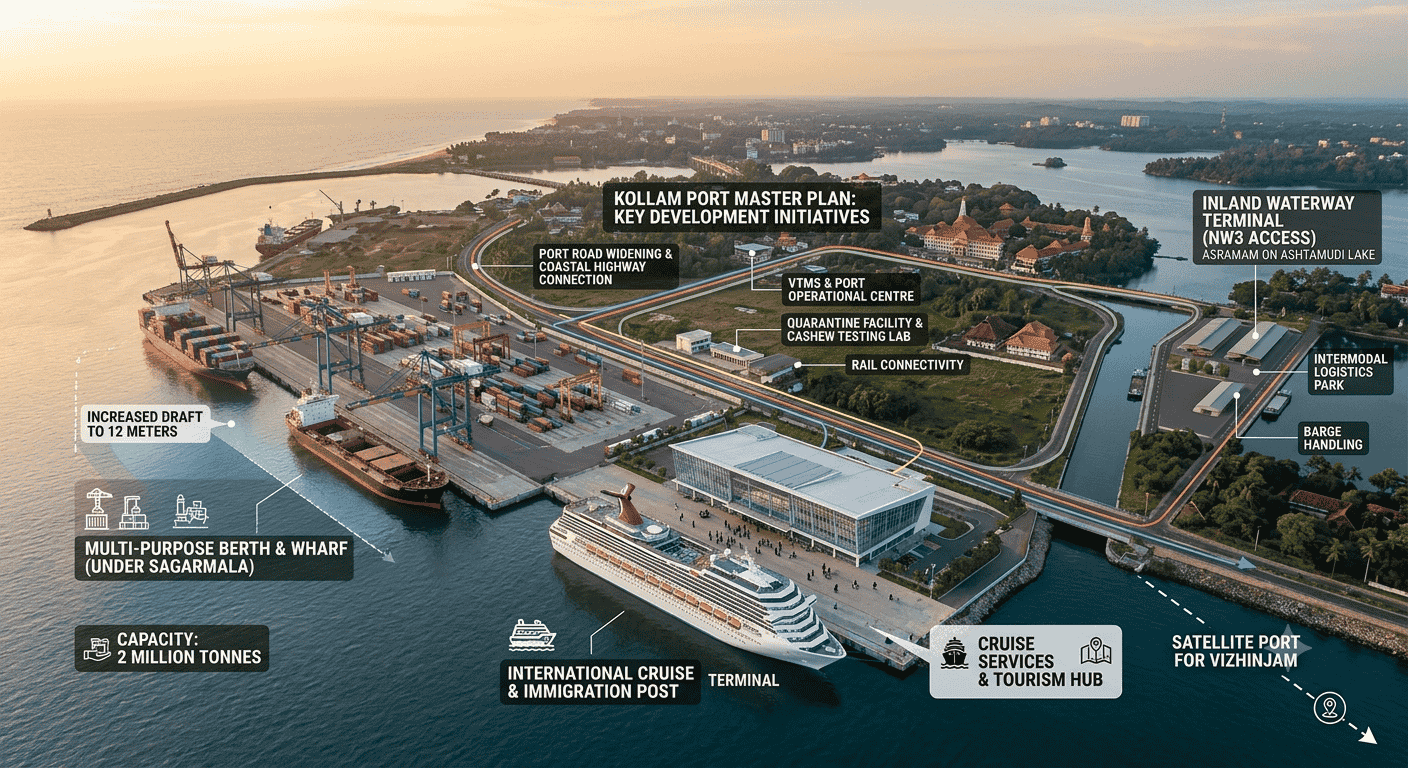
The maritime sector of Kerala is set to move into another stage as Kollam Port Becomes Vizhinjam’s Satellite Port becomes a significant milestone for the state. Since Vizhinjam International Seaport is taking up an increasing share in international shipping in India as well as in the EXIM business of the country, the focus is on how other ports close to the port can help in facilitating its increasing cargo needs. Kollam is one such port that is going to serve as a helper port with the aid of its infrastructure and location in Kerala’s southern coastline. Keralaport keeps its readers informed of the latest happenings in Kerala’s ports and maritime sector.
Why Is Kollam Port Being Developed as a Satellite Port?
A satellite port works alongside a larger port rather than operating completely independently. It can support the main port by handling some cargo, providing additional facilities and improving the movement of goods across the region.
The development of Kollam Port comes at a time when Vizhinjam International Seaport is expanding rapidly. Vizhinjam began full EXIM cargo operations in August 2026, adding direct export-import activity to its transshipment operations.
As cargo volumes increase, developing supporting ports such as Kollam could help create a more connected maritime network across Kerala.
Businesses interested in Vizhinjam’s growing logistics ecosystem can also read our guide on Vizhinjam Port Hinterland Connectivity, which explains why road, rail and last-mile logistics are becoming increasingly important.
What Are the Development Plans for Kollam Port?
The Kerala government has already taken several steps towards modernising Kollam Port.
In February 2026, the Kerala Cabinet approved the development of Kollam and Beypore ports through the Public-Private Partnership (PPP) model. The Kerala Maritime Board is responsible for preparing Detailed Project Reports and implementing development plans suited to the potential of each port.
A major development followed in August 2026 when the Union government sanctioned ₹7.24 crore under the Sagarmala Programme for a multipurpose berth and wharf at Kollam Port. The overall estimated project cost is ₹15.15 crore. The proposed development includes a 101-metre-long and 21-metre-wide wharf, along with supporting facilities.
These improvements are expected to strengthen Kollam’s ability to support cargo handling, logistics, warehousing, tourism and other maritime activities.
You can also explore our detailed Kollam Port Multi-Purpose Berth Project article for more information about this specific development.
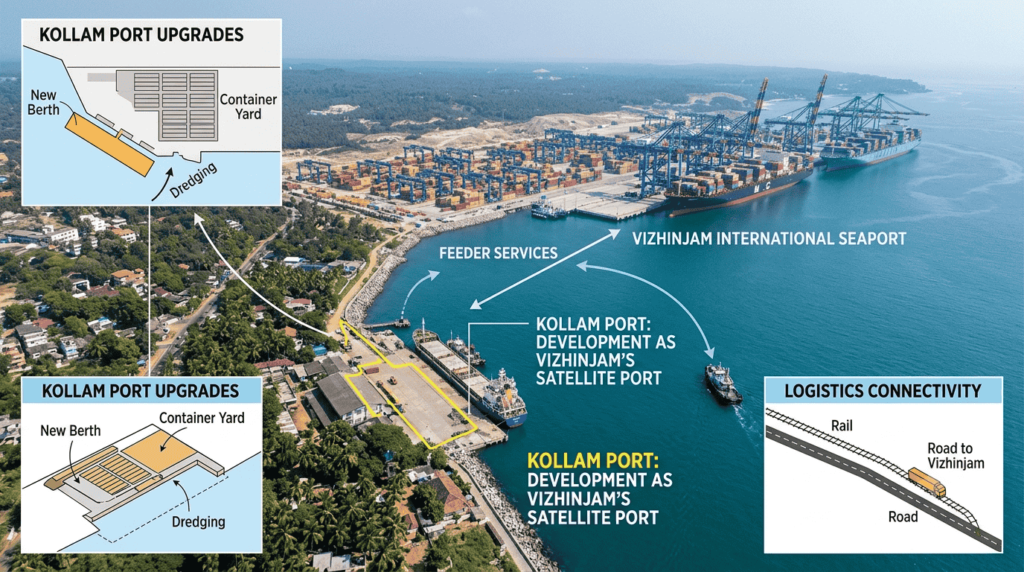
How Will Kollam Support Vizhinjam?
It need not be that Kollam should compete with Vizhinjam. There could be complementary uses for both ports.
Vizhinjam is strategically positioned because it is a deepwater port near international sea lanes, and its importance will increase over time due to its suitability for container ships and international EXIM cargo.
On the other hand, Kollam can become an important part of the regional network through:
- Coastal cargo transport
- Feeder and auxiliary shipping services
- Warehousing and logistics operations
- Regional cargo operations
- Tourist and passenger maritime activities
- Port and industry linkages in southern Kerala
As per the Kerala Maritime Board, Kollam already has two wharves, stacking area and cargo handling facilities in place.
Kollam Port and Mission Samudra
The development also fits into Kerala’s broader Mission Samudra strategy.
Launched in 2026 with a ₹400-crore allocation, Mission Samudra aims to create a stronger maritime ecosystem by connecting Kerala’s ports with transportation networks, logistics facilities, industrial areas and other economic activities.
This means Kollam’s development should be viewed as part of a wider strategy rather than as an isolated port project.
The objective is to create a network in which Vizhinjam, Kollam, Kochi, Beypore and other ports can contribute to Kerala’s overall maritime economy.
What Could This Mean for Businesses?
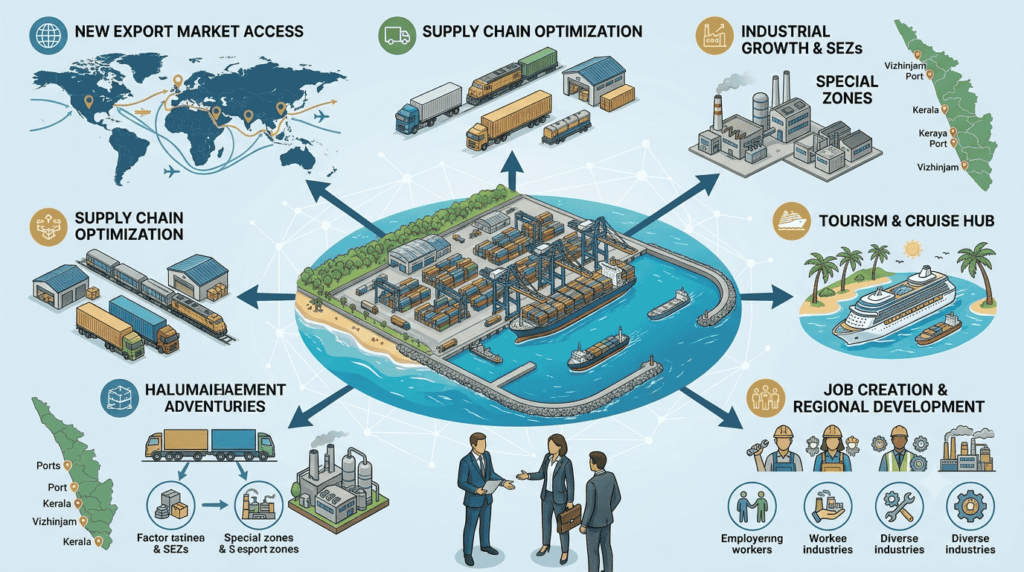
The strength of Kollam Port would open up fresh business opportunities for firms in southern Kerala.
Enhancement of port facilities would possibly make it simpler for manufacturers, traders, exporters, and importers to get their goods transported by sea. Better cargo facilities would also inspire logistics firms, warehousing firms, and other businesses to set up shop at the port premises.
For exporters, having several port facilities can give them options with respect to route choices and cargo handling procedures.
However, the success of the satellite-port concept is dependent on a number of elements, including cargo flow, private sector involvement, connectivity, infrastructure, and regular shipping service availability.
What Happens Next?
Kollam Port’s development is currently underway through various stages of development rather than completion of the transformation process. The PPP development scheme, multipurpose berth proposal and overall Mission Samudra initiative lay the ground for further development.
As the EXIM operations at Vizhinjam grew, the significance of developing the ports would become more pronounced. The location and infrastructure of Kollam might become an integral element of the new port system that is evolving in Kerala.
The critical point here is how fast the planned investments and private sector involvement will bring about real cargo and logistics traffic at Kollam.
Conclusion
The plan for Kollam Port to become Vizhinjam’s Satellite Port represents a shift towards a more connected port network in Kerala. Rather than relying on a single major gateway, the state is looking at how regional ports can complement Vizhinjam and support cargo movement, logistics, tourism and coastal economic activity. With PPP-based development, Sagarmala funding and the wider Mission Samudra programme moving forward, Kollam Port could become an increasingly important part of Kerala’s maritime future. For more latest news, project updates and developments related to Kerala’s ports and maritime sector, follow Keralaport and stay informed.