
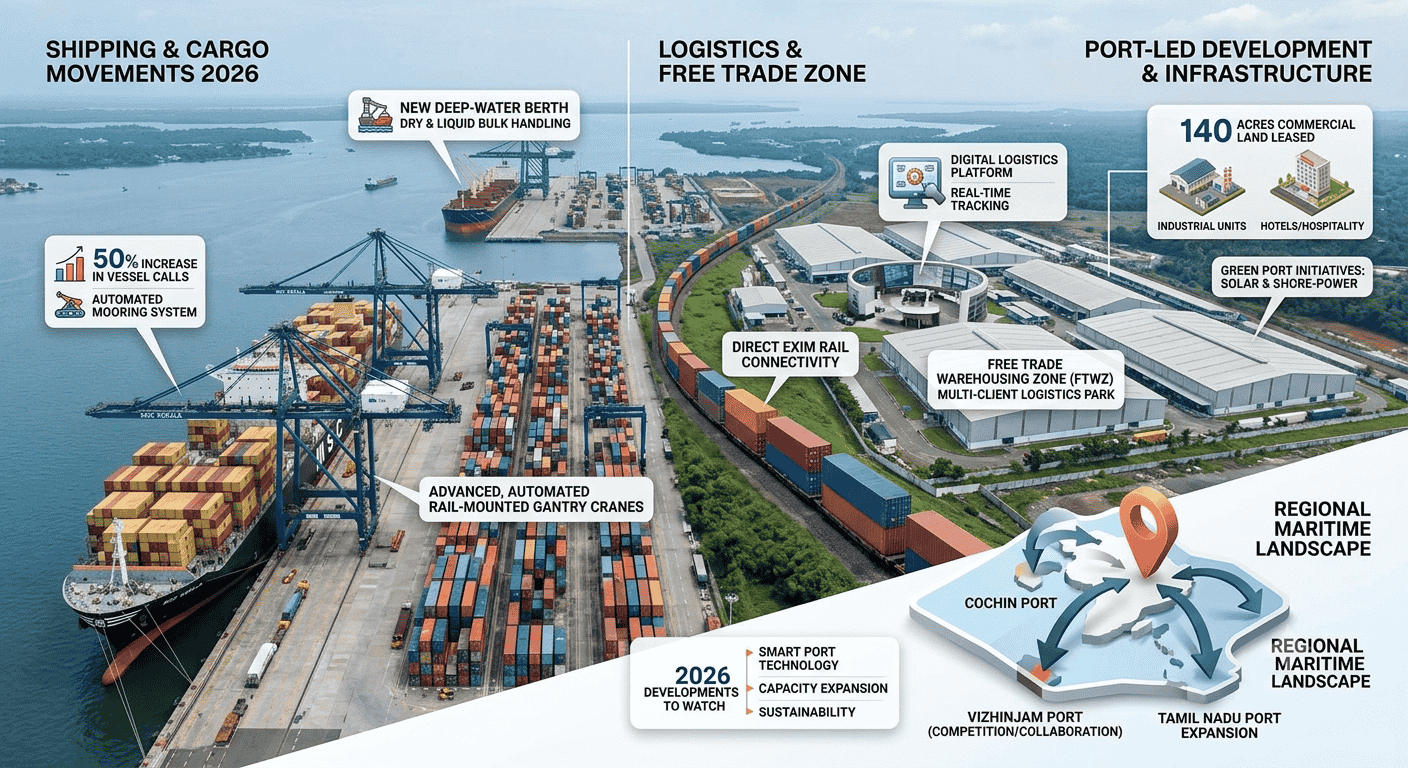
Cochin Port further establishes its reputation as one of India’s key marine ports with 2026 witnessing numerous developments in relation to cargo handling and containers, among others. Starting from breaking records in terms of cargo volumes to developing deeper channels and container handling facilities, the port is ready to accommodate bigger ships and facilitate trade.
The current developments have become especially important considering the increasing competitiveness of the maritime sector in Kerala with Vizhinjam International Seaport developing rapidly its transshipment and EXIM activities. For business, exporters, importers, shipping and logistics companies, it is crucial to be up-to-date about the latest trends and changes in this field.
Keralaport provides the latest information concerning developments in the sphere of ports, aviation, shipping, logistics and maritime infrastructure in Kerala.
Cochin Port Achieves Record Cargo Volume in 2026
The significant development of the Cochin Port in 2026 includes the record cargo volume.
As per the Cochin Port Trust, the port has managed to touch an all-time high cargo volume at 38.06 MMT, and even exceeded the figure of ₹1,000 crore financial turnover. For the current year, the Port Authority has fixed the target of moving above 40 MMT of cargo, with a long term vision of crossing the figure of 50 MMT of cargo within the next four to five years.
This reflects that the significance of Kochi in the Indian trade continues to remain high.
The Cochin Port has managed to process many different kinds of cargo like petroleum products, crude oil, liquid bulk, containers, etc. The presence of the port on the Arabian Sea and international shipping routes provides an added advantage to the port for conducting trade for the region of Kerala and southern India.
For businesses dealing with cargo transport, warehousing, manufacturing and international trade, increase in the port capacity can be beneficial.
Vallarpadam Terminal Remains a Key Growth Engine
DP World’s International Container Transshipment Terminal (ICTT) located at Vallarpadam in Cochin Port continues to be the focal point for the port’s container business.
For instance, in May 2026, the ICTT recorded a throughput of 77,637 TEUs as per reports by Keralaport. This record throughput has been made possible through increased transshipment, more ships visiting the ports and increase in volume of cargo.
This is important because Vallarpadam is an area that was designed for the purpose of giving India a transshipment center that will allow for direct connection of Indian cargo to international shipping.
Things are fast changing, however, due to the emergence of Vizhinjam International Seaport as another transshipment center in Kerala.
According to a recent analysis by The Loadstar, there has been increasing competition for transshipment cargo at Vallarpadam from Vizhinjam.
Channel Deepening to Support Larger Container Ships
Another significant trend to observe is the enhancement of the channel to the ICTT.
In March 2026, the Cochin Port Authority tendered consultancy services for EIA and environmental and CRZ clearances for capital dredging with the intent of facilitating the docking of vessels with drafts of 16 metres at ICTT.
This is a strategically important step as deeper access will be an opportunity to increase the capability of the port to handle bigger container ships, thereby enhancing the competitiveness of the port within the region.
This is part of an overall modernization program that involves the container terminal and marine assets.
Instead of viewing the problem of deepening the channel as an engineering challenge, it is more effective to look at it as a logistics strategy.
For one, big ships can transport more cargo per trip, while better connectivity will aid in network optimization by shipping lines.
Major Investment Commitments Are Supporting Modernisation
Cochin Port’s development is also being supported by significant investment commitments.
During India Maritime Week 2025, Cochin Port Authority signed 10 MoUs involving investment commitments of approximately ₹10,000 crore. According to Keralaport’s coverage, these included investments connected with shipbuilding infrastructure and improvements to cargo-handling facilities at Vallarpadam.
One of the significant commitments was around ₹1,500 crore from IGTPL (DP World) for enhancing cargo handling at the International Container Transshipment Terminal.
These investments are important because port competitiveness is no longer determined only by berth capacity. Modern ports require efficient equipment, storage yards, digital systems, road and rail connectivity, warehousing and supporting industrial infrastructure.
Smart Industrial Port City: A New Dimension for Cochin Port
Cochin Port is also looking beyond conventional cargo handling.
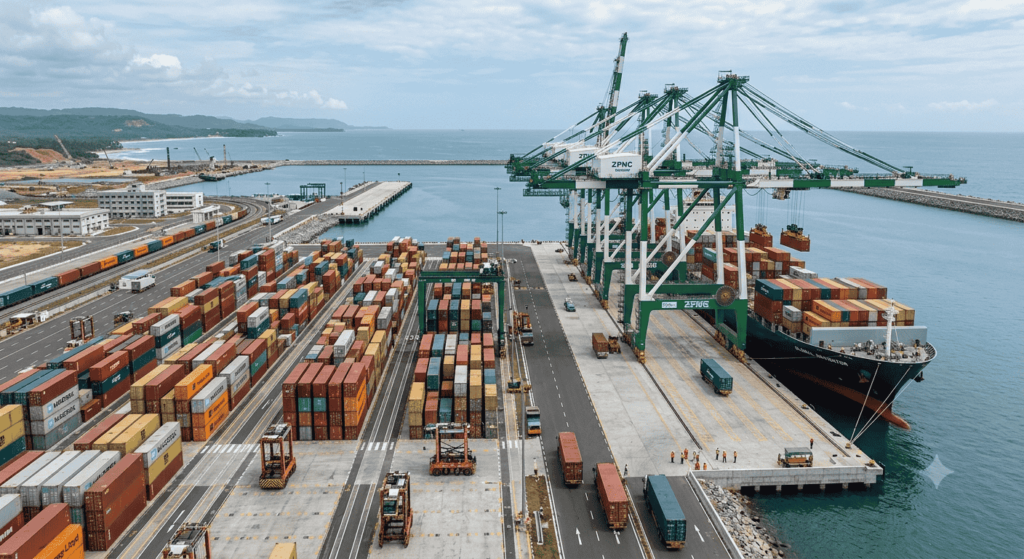
In February 2026, the Cochin Port Authority announced the appointment of consultants for implementation of a Smart Industrial Port City (SIPC), including technical advisory and project management consultancy.
This indicates a broader shift towards port-led industrial development.
A modern port can generate economic value not only through ship calls and cargo handling but also through industries, logistics parks, warehousing, manufacturing, maritime services and other businesses located around the port ecosystem.
For Kerala, this could create opportunities for companies involved in freight forwarding, customs clearance, transportation, storage, marine services and export-oriented manufacturing.
Geopolitical Disruptions Highlight the Importance of Flexible Logistics
Global shipping conditions have also affected Cochin Port in 2026.
The Cochin Port Authority issued several trade notices relating to the impact of geopolitical disturbances in the Middle East, including measures concerning containers stranded inside the port and cargo bound for the Middle East.
These developments highlight an important reality for the logistics sector: ports must be prepared to respond quickly when international shipping routes face disruption.
For Indian exporters and importers, having multiple logistics options and reliable regional ports can reduce dependence on a single international route or transshipment hub.
Cochin Port and the Changing Kerala Maritime Landscape
Cochin Port is entering an interesting period.
On one side, it has an established maritime ecosystem, the Vallarpadam container terminal, industrial facilities and decades of experience handling international trade. On the other, Vizhinjam is rapidly developing as a deep-water transshipment and EXIM hub.
Rather than viewing this only as a competition, Kerala’s ports could potentially serve different segments of the maritime economy.
Cochin can continue strengthening its container, bulk, industrial and logistics ecosystem, while Vizhinjam focuses heavily on deep-water transshipment and international mainline connections.
The growth of both ports could ultimately strengthen Kerala’s position in India’s maritime trade network.
What to Watch at Cochin Port in the Coming Months
The most important developments to monitor include:
- Cargo: Whether Cochin Port crosses the 40 MMT target.
- Vallarpadam: Continued growth in container and transshipment volumes.
- Channel deepening: Progress towards enabling vessels with up to 16-metre draft.
- Terminal investment: Implementation of planned cargo-handling improvements.
- Smart Industrial Port City: Progress towards port-led industrial development.
- Logistics: Growth in warehousing, freight forwarding and multimodal connectivity.
- Competition: How Cochin and Vizhinjam evolve alongside each other.
- Global shipping: The impact of geopolitical disruptions on vessel calls, cargo flows and freight costs.
For official port notices and current operational information, readers can also check the Cochin Port Authority website.
Conclusion
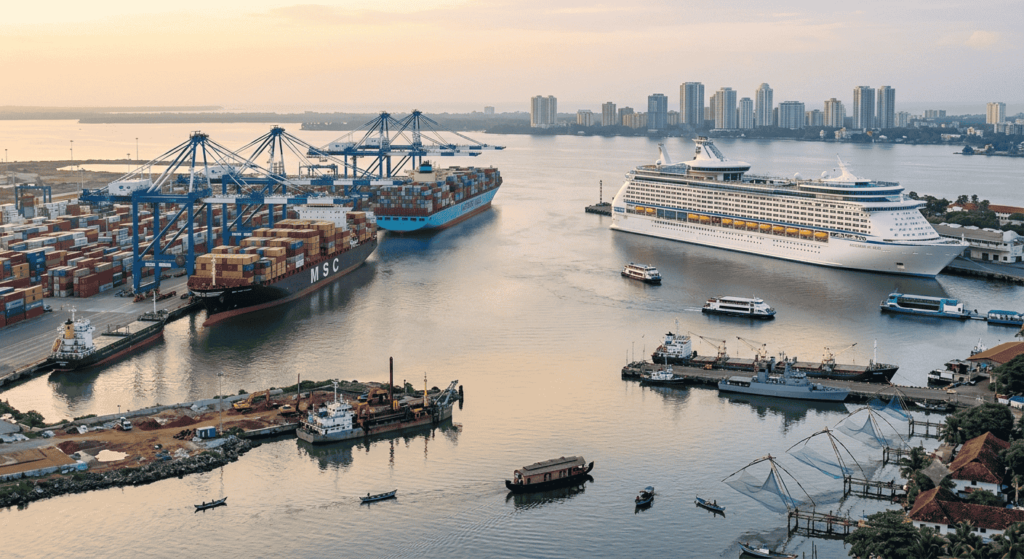
From the Cochin Port Latest Updates 2026, it is clear that the city of Kochi is gearing up to enter an exciting new chapter in its maritime history. The unprecedented 38.06 MMT cargo handling capacity, over ₹1,000 crore revenue generation, top-notch performance at Vallarpadam Container Terminal, and the upcoming plans for channel deepening are signs of a port getting ready for India’s future trade needs.
But the growing significance of Vizhinjam also shows that the maritime industry of Kerala is becoming more dynamic and competitive than ever before. The coming period will be crucial for Cochin Port in establishing itself as a leading port in container transport, bulk cargo handling, port-centric industrialization and logistics.
Keralaport will keep bringing you the latest updates on the developments at Cochin Port, Vizhinjam, other ports of Kerala, airports, shipping and maritime industries of Kerala.
Stay Updated with Keralaport
Looking for latest news on Kerala ports, shipping, cargo, and logistics? Follow Keralaport.