
The maritime logistics scene of India has entered into an interesting period, where Vizhinjam International Seaport will not only be confined to being a transshipment port but also extend its gateway cargo capacity.
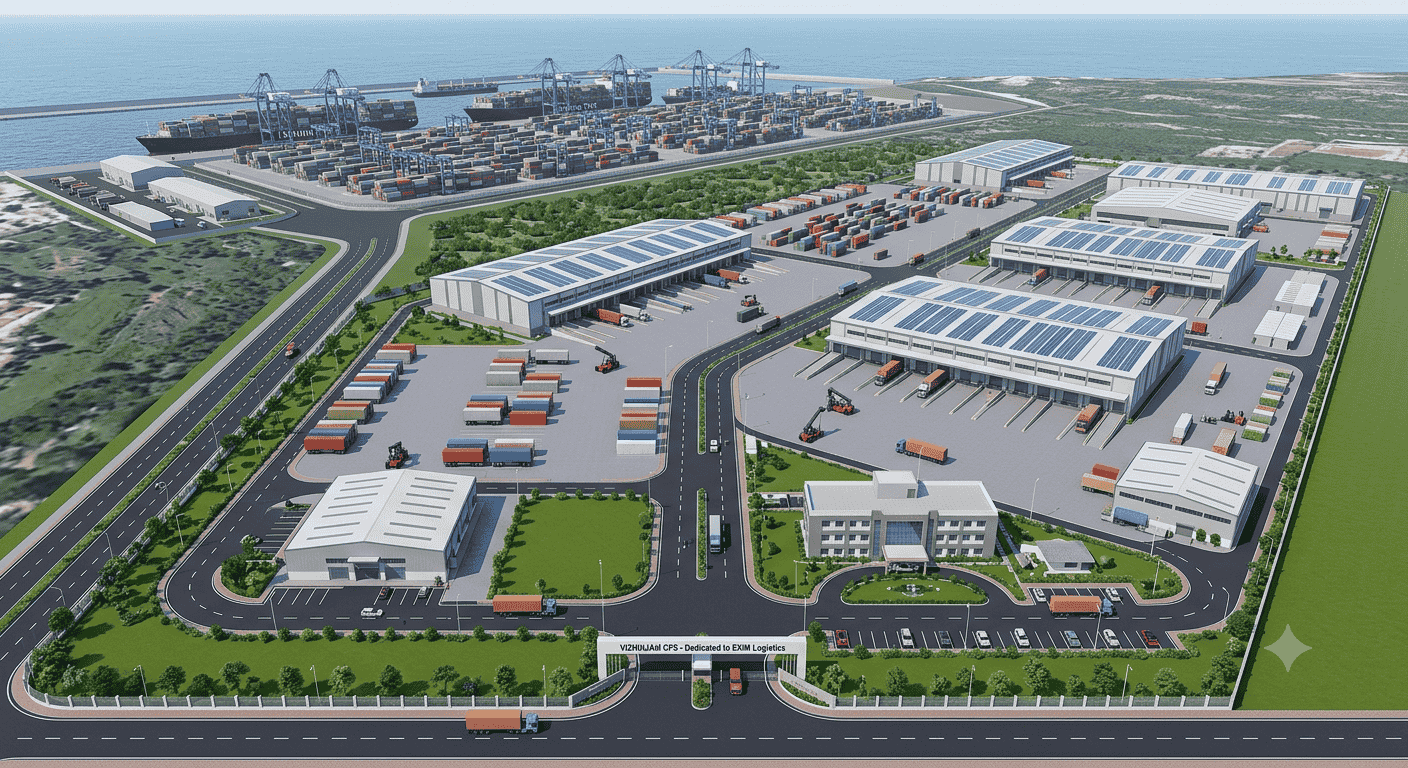
There is one development which is catching everyone’s eye, that is, the Vizhinjam Port 100-Acre CFS Plan. Adani Ports has planned for construction of a 100-acre Container Freight Station (CFS) near the port so as to manage gateway cargo. This is happening during an interesting time, when Vizhinjam commenced its EXIM Cargo operations from 18th August 2026, post final customs clearance.
This 100-acre CFS could prove to be a crucial connection between the port, custom process, exporters, importers, transporters, and the entire logistics chain.
The business community tracking the maritime sector of Kerala should be able to recognize this development as something beyond just warehousing facility.
What Is the Vizhinjam Port 100-Acre CFS Plan?
A Container Freight Station is a facility designed to receive, consolidate, de-stuff, stuff, store temporarily, and process containerized cargoes for further transportation.
Based on recent reports, Adani Ports intends to set up a 100 acre CFS at Vizhinjam as the volume of EXIM cargo increases. This facility is seen to be meeting an important logistics need as the port expands its gateway operations.
It is significant in the sense that a CFS is capable of conducting different operations of cargo that are not always possible through port delivery alone.
The present proposal needs to be seen in the context of the overall evolution of Vizhinjam as a gateway facility.
Why Does Vizhinjam Need a CFS?
The launch of EXIM activities transforms the requirements of the logistics chain of the port.
For the first stage, customs procedures have imposed some restrictions on cargo which can be loaded or discharged without the use of any facility.
As per the recent reports, some less than container load, bulk cargo, and de-stuffing cargoes need CFS to discharge.
Here comes the importance of the proposed 100 acre facility.
Well equipped CFS would provide the following services:
- Consolidation and deconsolidation of cargoes
- Handling of imports/exports cargo
- Storage of cargo
- Stuffing/De-stuffing services
- Customs related process
- Container examination
- Documentation and logistics service
- Road transportation services
In other words, CFS acts as the intermediate link between seaport and inland supply chain.
From Transshipment Hub to EXIM Gateway
Vizhinjam’s strategic advantage has traditionally been its location close to the major international east-west shipping route.
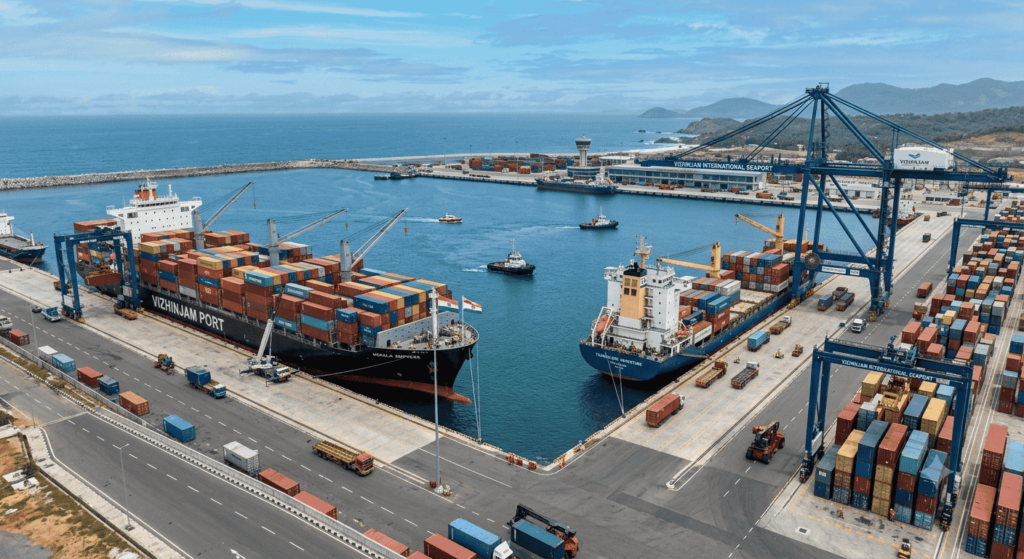
The official Vizhinjam International Seaport website highlights the port’s proximity to the international shipping route and its natural deep-water characteristics. The port is designed to accommodate large container vessels and function as a major transshipment hub.
Now, the next stage is developing its gateway cargo ecosystem.
The port’s official business strategy says Vizhinjam is targeting a substantial increase in EXIM cargo over the next decade, from around 0.15 million TEUs to 1.5 million TEUs annually. It also identifies CFSs, inland container depots, multimodal logistics parks, free-trade warehousing zones and specialised cold-chain infrastructure as part of the emerging EXIM logistics ecosystem.
That makes the proposed CFS particularly significant.
How Could the 100-Acre CFS Boost EXIM Trade?
1. Faster Cargo Processing
One of the biggest benefits of a CFS is the ability to move cargo through different stages of the logistics process without relying entirely on port-terminal infrastructure.
Faster cargo processing can help reduce delays for importers and exporters and improve supply-chain predictability.
2. Support for Small and Medium Exporters
Not every exporter operates with full-container-load shipments.
CFS infrastructure is particularly useful for less-than-container-load (LCL) cargo, where shipments from multiple exporters can be consolidated.
This could create opportunities for Kerala’s MSMEs, manufacturers, traders and agricultural exporters to make greater use of Vizhinjam.
3. Better Customs and Cargo Examination
A dedicated CFS provides space for cargo examination, documentation and related customs procedures.
This becomes increasingly important as EXIM volumes grow and the port handles a wider range of cargo.
4. Stronger Road Logistics
The CFS can also become a key interface between the port and trucking network.
Efficient movement between Vizhinjam → CFS → warehouse → industrial unit → customer can help create a more integrated logistics chain.
5. Foundation for Multimodal Logistics
Road transport is only one part of the long-term strategy.
A planned rail connection is expected to further strengthen Vizhinjam’s hinterland connectivity. The Centre has also stated that the port’s capacity expansion is being implemented with a target of December 2028, with capacity expected to rise substantially.
The combination of port + CFS + road + rail + warehouses could significantly strengthen the region’s logistics infrastructure.
The Bigger Picture: Vizhinjam’s Port-Led Industrialisation
The CFS should not be viewed in isolation.
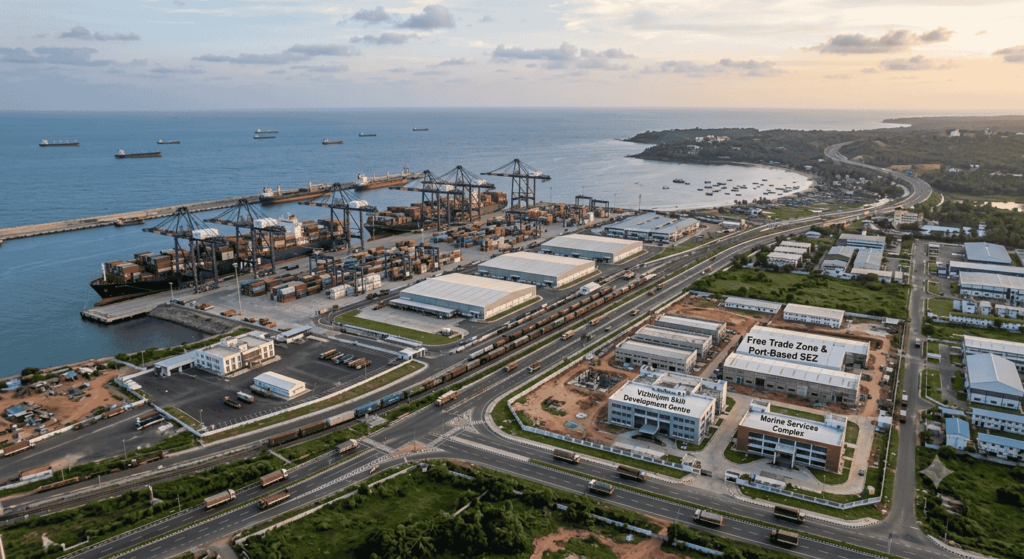
Vizhinjam International Seaport Limited says it is planning port-led industrialisation across approximately 3,500 acres in three phases, with 230 acres currently being acquired for Phase I. The planned ecosystem includes multimodal logistics parks, ICDs, FTWZs, CFS facilities, cold-chain infrastructure and truck terminals.
This creates a much larger opportunity.
As logistics infrastructure develops around Vizhinjam, industries that depend on efficient import and export connectivity could find the region increasingly attractive.
Potential sectors include:
- Food and agro-processing
- Automotive and EV components
- Electronics and IT-related manufacturing
- Pharmaceuticals
- Chemicals
- Tourism-related logistics
- Warehousing and distribution
This could gradually transform the southern Kerala coastline into a more integrated maritime-industrial corridor.
What About the Existing CFS Plans?
Interestingly, the idea of CFS and warehousing around Vizhinjam is not entirely new.
The earlier Vizhinjam master plan had already identified land requirements for CFS and warehousing and discussed facilities such as container yards, warehouses, customs offices, parking, access roads, weighbridges and electronic data interchange systems.
The difference today is the scale and urgency.
With EXIM operations now underway, the requirement for supporting infrastructure is becoming much more immediate.
The current 100-acre CFS proposal therefore represents the next stage of a logistics requirement that had already been recognised in Vizhinjam’s long-term planning.
What Could This Mean for Kerala Businesses?
For Kerala businesses, the development could bring the port closer to their everyday supply-chain operations.
Exporters may benefit from improved access to international shipping services, while importers could potentially gain from more streamlined cargo handling and distribution.
The wider impact could extend to:
- Freight forwarding
- Customs clearance
- Trucking
- Warehousing
- Container handling
- Packaging
- Cold-chain logistics
- Port-related services
- Maritime support services
The official Vizhinjam business plan itself projects substantial employment and investment potential from the wider port-led industrialisation programme.
Vizhinjam’s Next Challenge: Building the Ecosystem Around the Port
A successful port is not determined only by the number of ships it can accommodate.
The real test is how efficiently cargo can move from ship to port, from port to CFS, and from CFS to businesses and consumers.
That means infrastructure such as the proposed 100-acre CFS, rail connectivity, warehouses, logistics parks and road networks will be critical to Vizhinjam’s long-term success.
The port is already undergoing a major capacity expansion, with Phase II targeting a substantial increase in container-handling capacity. Adani Ports’ 2026 reporting also notes that EXIM-related infrastructure, including a CFS, container depot and EXIM yard, is being developed to strengthen cargo handling.
Conclusion
Vizhinjam Port 100 Acre CFS Project can serve as an important part of developing maritime logistics infrastructure of Kerala.
As the operations at Vizhinjam are going to switch into EXIM mode, there will be an increased demand for efficient cargo consolidation, processing and inland transportation. In this regard, construction of a large CFS can help create better connections between the port terminal and the rest of the logistic chain.
More importantly, the project itself represents another milestone in development of Vizhinjam – the transition from a deepwater transshipment center to a more comprehensive gateway for EXIM cargo and industrial development based on the port.
For businesses, logistics experts and all those interested in maritime affairs in Kerala, the next few years will be decisive. The progress in development of CFS infrastructure, rail connections, warehouses, logistics hubs and industry investments will determine how well Vizhinjam will convert its natural and strategic advantages into sustainable economic growth.
Keralaport provides you and your business with the most recent news on developing maritime infrastructure of Kerala. Subscribe to Keralaport and find out the latest developments regarding Vizhinjam Port, EXIM cargo operations and other news from the maritime sector of Kerala.
Stay Updated with Keralaport
Curious about what is going on in Vizhinjam and other Kerala ports?
Follow Keralaport to get all the latest news and updates on ports, shipping, logistics, airports and maritime infrastructure projects of Kerala.