
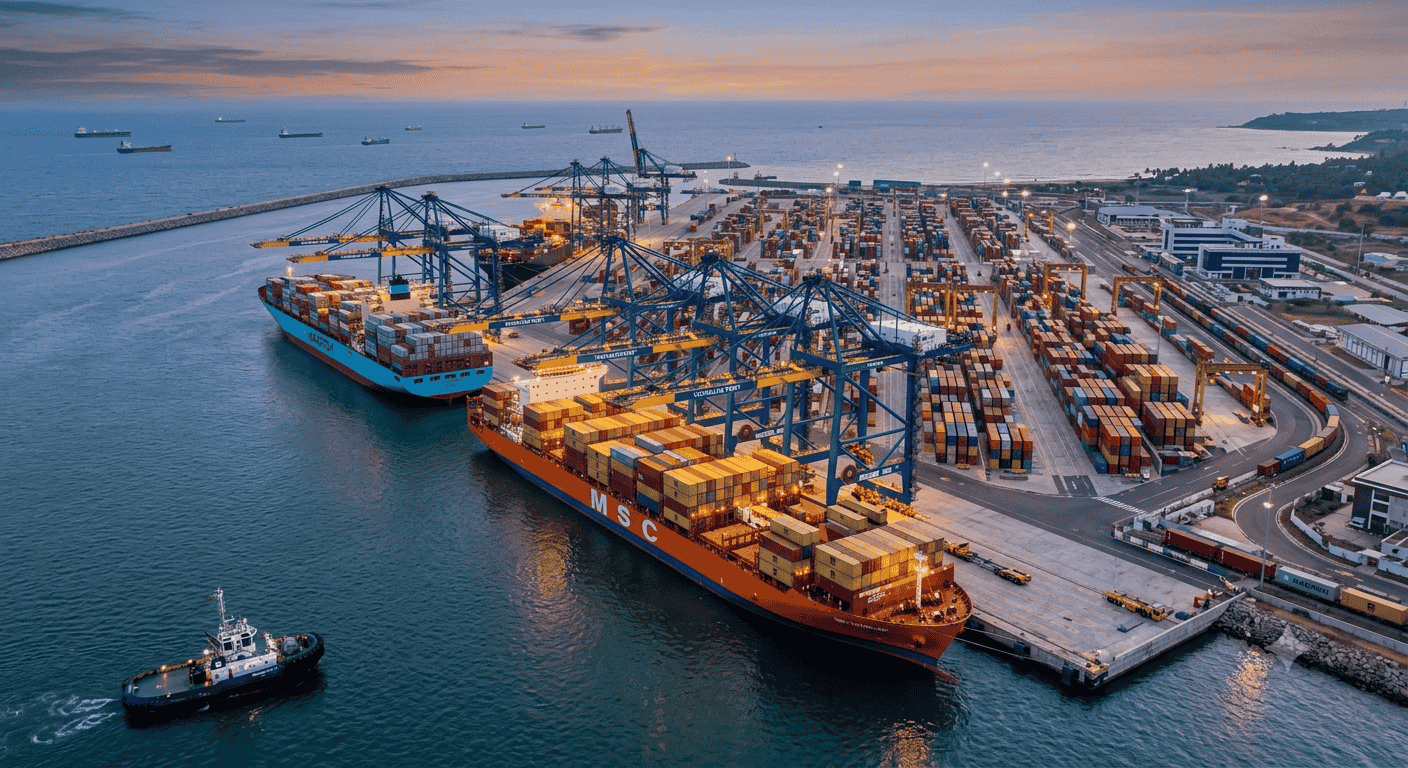
India is one of the fast growing trading nations in the world, but quite a good percentage of the nation’s container cargo in terms of international trade relies on transshipment in ports outside India such as Colombo, Singapore, and Jebel Ali among others. Such reliance has brought about high cost of logistics, long transit time, and lack of control over the maritime trade in India.
But things are now taking a different turn because of the establishment of the Vizhinjam International Seaport which has become one of the greatest infrastructural changes that have happened to India. The seaport, which is strategically located on one of the busiest international shipping routes, is playing a crucial role in helping India realize the goal of Maritime Self-Reliance in 2026 through EXIM services.
Interested readers in the maritime development in Kerala can get information from Keralaport.
Understanding India’s Maritime Self-Reliance in 2026
Maritime self-sufficiency means that India would be able to take care of its international cargo, its shipping infrastructure, and logistics network without being overly dependent on foreign ports.
In the past, more than two-thirds of India’s transshipment cargo was being funneled through foreign ports. For every container shipped internationally, India incurred additional cost and loss of economic opportunity.
Today, the national maritime strategy includes the following key initiatives:
- Creation of state-of-the-art transshipment ports
- Cost-cutting logistics operations
- Supply chain resilience
- Export competitiveness
- Blue economy
- Employment generation via port-led development
Vizhinjam Port helps achieve all the above goals of the nation.
Why Vizhinjam Port is Strategically Important
Unlike other ports in India, the Vizhinjam Port has certain natural advantages.
The port is strategically situated less than 10 nautical miles away from the important east-west passage through which ships pass from Europe, Middle East, Africa, and Asia. Its geographical location makes it convenient for large container ships to make calls at the port without any deviation from their world voyages.
Some of the other important advantages are:
- Natural depth of about 24 meters
- Ability to cater to the ULCS vessels
- Little dredging necessary
- First of its kind deep water transshipment port in India
- Modern port facilities with automation
Reducing Dependence on Foreign Transshipment Ports
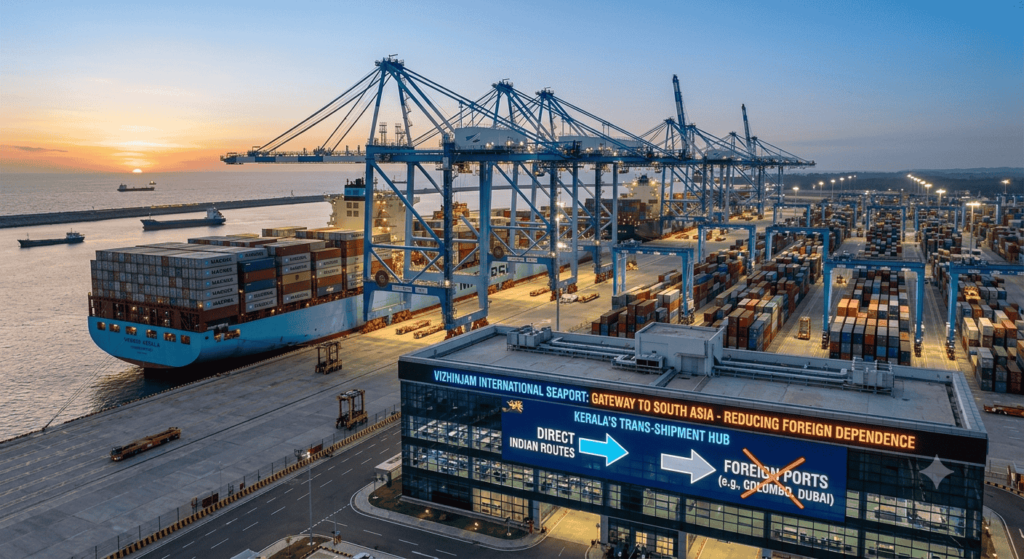
One of the biggest contributions toward India’s Maritime Self-Reliance in 2026 is reducing reliance on overseas transshipment hubs.
Previously, Indian exporters and importers often depended on foreign ports for transferring containers to larger international vessels. This resulted in:
- Additional handling costs
- Higher freight expenses
- Longer delivery schedules
- Increased exposure to geopolitical risks
Vizhinjam Port enables more cargo to remain within India’s logistics network, helping retain revenue, improve efficiency, and strengthen national supply chain security.
Boosting India’s Global Trade Competitiveness
The competitiveness of a nation is very much influenced by the port efficiency of that nation.
Due to the deep water facilities of Vizhinjam, the world’s biggest container ships can directly call at this port without relying on feeder ships, making their transportation more efficient.
Some advantages are:
- Increased efficiency in movement of goods
- Lower cost of logistics
- Competitive exports
- Increased turn-around time
- Reliability for international shipping companies
With the changing dynamics of global trade, efficient ports are definitely an advantage for India.
Expansion Plans Driving Future Growth
The port is not stopping with its current operational capacity.
Major expansion initiatives are underway to significantly increase container handling capabilities over the coming years.
The ongoing development includes:
- Additional berths
- Extended breakwater
- Railway connectivity
- Expanded logistics infrastructure
- Future industrial ecosystem around the port
These developments will strengthen India’s long-term maritime capacity while supporting sustainable economic growth.
EXIM Operations Mark a Major Milestone
A significant milestone in 2026 is the commencement of Export-Import (EXIM) operations at Vizhinjam Port.
The launch of EXIM services represents a major step forward because it enables the port to handle both international imports and exports directly, making it an even stronger contributor to India’s trade ecosystem.
The development is expected to:
- Increase cargo volumes
- Support exporters
- Improve customs efficiency
- Create employment opportunities
- Strengthen Kerala’s logistics sector
This marks another important chapter in India’s maritime transformation.
Supporting India’s Blue Economy
India’s Blue Economy strategy focuses on sustainable utilization of ocean resources for economic growth.
Vizhinjam Port supports this vision through:
- Maritime infrastructure development
- Coastal economic growth
- Logistics investment
- Employment generation
- International trade facilitation
- Future industrial development
As port-led industrialization expands, businesses involved in warehousing, shipping, logistics, customs, and manufacturing are expected to benefit significantly.
Recent Developments Strengthening the Port
Several recent developments demonstrate the growing importance of Vizhinjam.
Recent updates include:
- Expansion of cargo operations
- Upcoming modern fire safety infrastructure
- Resumption of crew change operations for international shipping
- Continued investment in logistics facilities
- Growing international shipping interest
These improvements strengthen operational efficiency while positioning the port as a global maritime hub.
Economic Benefits for Kerala and India
The impact of Vizhinjam extends beyond shipping.
The port is expected to generate long-term benefits including:
- New employment opportunities
- Increased foreign investment
- Growth of logistics parks
- Expansion of warehousing facilities
- Better multimodal connectivity
- Increased exports
- Higher government revenue
- Regional industrial development
These benefits contribute directly to India’s vision of becoming a global manufacturing and logistics powerhouse.
Challenges Ahead
Although the future looks promising, several challenges remain.
Some important priorities include:
- Faster rail connectivity
- Completion of expansion phases
- Development of logistics parks
- Skilled workforce availability
- Emergency infrastructure upgrades
- Sustainable environmental management
Addressing these challenges will help maximize the port’s long-term potential.
Conclusion
The Vizhinjam International Seaport is much more than just another shipping port—it is a vital national asset that will help determine the future of India’s maritime industry. In terms of lowering the dependence on overseas transshipment terminals, drawing shipping companies from abroad, enhancing the logistics efficiency, and exporting goods, the port is playing an important role in India’s self-reliance in the maritime industry in 2026. As the port expands its infrastructure, increases the cargo capacity, and accomplishes more trade achievements such as EXIM operations, Vizhinjam can become one of the most important ports of India.
For the latest news about Vizhinjam Port, the ports of Kerala, the maritime infrastructure, shipping, logistics, and airports, visit Keralaport.
No matter if you are an expert in logistics, a businessman, investor, student, or just an admirer of maritime affairs, Keralaport is the right place for getting the most recent information about Kerala’s ports and airports.
Get more exclusive information only at Keralaport.